














ZODIAK ONLINE
ArtBridge House, Area 47
Sect. 5, P/Bag 312
Lilongwe, Malawi
Sect. 5, P/Bag 312
Lilongwe, Malawi


In Malawi, drug stores and private clinics have become as common as grocery stalls, sprouting in towns and villages alike.
Most are run by trained medical professionals who, beyond their calling to heal, have embraced entrepreneurship to supplement meagre government salaries.
Yet this pursuit of profit has opened a dangerous trade. Behind the counters, pharmacies are quietly breaking the law, selling prescriptiononly sexual enhancement pills, the so called blue tablets, without medical approval.
In this article, reporters Innocent Kumchedwa and Eamon Piringu investigate how the very people entrusted to save lives are fuelling a silent crisis.
Their findings reveal a deadly pattern: men lured by promises of pleasure are buying the pills freely, unaware of the risks. From January to June alone, five have died. What began as a side business for survival has become a perilous gamble with human life.
In the fading light of late afternoon, panic tore through one of Lumbadzi’s pleasure centers.
A young woman in her early twenties burst out of a room, her voice trembling as she pleaded for help.
Inside, the man she had been with lay collapsed, motionless.
He was rushed to a nearby health facility, but medics could only confirm the worst, the young man was dead.
Police moved in swiftly. Their investigation uncovered two boxes of sexual enhancement pills in the room. One box had four tablets missing, the other just a single pill consumed.
According to confidential police report we have reviewed, the deceased’s partner revealed a chilling detail: the man had swallowed five pills in quick succession, a cocktail of sexual enhancers, locally known as “blue pills.”
The discovery raises troubling questions. Why are such potent drugs so easily accessible? Who regulates their sale, and how many more lives are at risk in Malawi’s growing shadow market of performance enhancers?
To investigate this issue, and to seek answers to the troubling questions it raises, we employed several methods: opensource research, undercover reporting, interviews, and internet searches.
Drawing on Zodiak’s extensive network of reporters across Malawi, we assembled a team of reporters who went undercover to trace where sexual enhancement drugs are being sold, and to attempt purchasing them.
Our internet search revealed that all sexual enhancement drugs in Malawi fall under the regulation of the Pharmacy and Medicines Regulatory Authority (PMRA).
Officially, these drugs are classified as prescription only medicines.
In principle, they should only be dispensed when prescribed by a qualified medical doctor at a clinic or hospital.
Yet our undercover reporters found a different reality. Walking into pharmacies at random, they were able to access the drugs without being asked for a doctor’s
prescription.
Through data compiled by our reporters, we established that more than 20 different sexual enhancement products are being sold in pharmacies across Malawi.
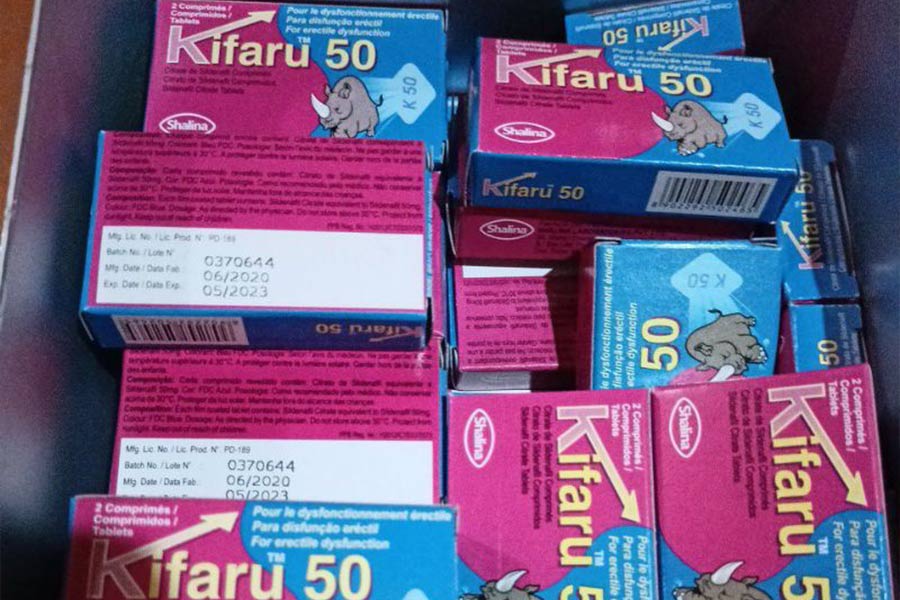
This finding was crosschecked against official records from the Pharmacy and Medicines Regulatory Authority (PMRA), which lists 54 sildenafil-based products on its register.
Sildenafil, best known globally under the brand name Viagra, is a prescription medicine. It is a potent drug used to treat erectile dysfunction in men and pulmonary arterial hypertension in both men and women.
Yet in every pharmacy our undercover reporters visited, no prescription was requested. The drugs were sold over the counter, as casually as any walk-in
purchase.
Zodiak Broadcasting Station commands the country’s widest reporting network, the only media house with correspondents in all 28 districts of Malawi.
To probe the rising deaths of men linked to sexual performance drugs, we set out to uncover how these pills are being accessed.
We assembled undercover teams in Rumphi and Mzuzu in the north; Lilongwe, Dowa and Dedza in the centre; and Machinga, Mwanza and Mulanje in the south. Each reporter was instructed to enter pharmacies and attempt to buy sexual enhancement drugs.
In every district, the reporters purchased the pills without being asked for a doctor’s prescription or any form of medical clearance. In Lilongwe, Rumphi, Mwanza and Mulanje, they were able to buy more than two packs each of the blue tablets, with every pack containing five pills.
We followed up the undercover findings by interviewing some of the men who use these pills. The interviews revealed a striking pattern. Men across districts such as Rumphi, Lilongwe, Dedza, Mulanje, Machinga, Mwanza and beyond admitted they use these drugs purely for pleasure, not under medical advice.
Their accounts tell a consistent story, one of experimentation, exploration, and recreational use.
In Dedza, John Makiyoni explained that he takes the pills to “match with his wife’s energy,” as she is on contraceptives.
He believes his declining sexual stamina is linked to the contraceptives: “I took the pills because of the effects of female contraceptives which reduce manpower.
These pills help restore a man’s sexual prowess.”

In Rumphi, Adam Kumwenda admitted he began using the pills because of peer pressure. Friends told him he would be admired by girls for “incredible sexual power.”
He said: “I have once used the blue pills. It is common in pharmacies. As youths, we usually discuss how to satisfy a woman sexually — that’s the reason I opted to take these pills. They sell at K1,000.”
From Mulanje, Osward Mandalena shared his experience: “I started to use the blue pills because I wanted to boost my energy and explore. On the first day of using it, I felt my manhood stronger than ever before.”
Throughout our interviews with men using sexual enhancement drugs, a common belief emerged: that these pills guarantee improved sexual performance and greater satisfaction for their partners.
But experts warn the story is more complex. Donald Makwakwa, Director of the Family Planning Association of Malawi, told us the crisis goes beyond medicine.
He argues it reflects deeper societal pressures, expectations of masculinity, sexual performance, and the unspoken burden of mental health among men.
“These drugs are now readily available, and some people take them simply out of curiosity. Sadly, we have learned of cases where individuals have died in the process,” said Makwakwa.
The use of sexual enhancement drugs is not new in Malawi. But what has driven our investigation is a disturbing trend, the rising number of deaths linked to their use.
Police data we reviewed show that between January and June this year alone, five men have died after consuming sexual enhancement pills.
We put the question directly to the Pharmacy and Medicines Regulatory Authority, seeking clarity on how these deaths are occurring.

Director General Charles Chimenya pointed to three key factors: “First, there is the risk of overdosing, which you have already noted. Second, someone may have an underlying condition — most often heart-related diseases.”
“In some cases, the drugs may already be in use for other medical conditions. Ultimately, adverse events can also be linked directly to the product itself.”
Pharmacist Dr. John Mponda has issued a stark warning. He urges both pharmacy owners and customers to act responsibly, stressing that the law is clear: sexual enhancement drugs should only be dispensed after being prescribed by a qualified medical doctor.
“We must take time to advise and assess our clients who may need these medications — especially those with hypertension, heart problems, or other special conditions,” said Mponda.
Pharmacies, like hospitals, are meant to be places of hope, spaces where people seek relief and healing.
Yet, driven by the pursuit of profit, some facilities are abandoning their legal duty: selling sexual enhancement drugs without the required prescription.
The consequences have been deadly. Five young men have already been sent to an early grave between January and June this year. And while official figures confirm five deaths, it is no secret that others have survived near-fatal experiences but lacked the courage to report to hospital.
One such case is that of Ackim Yesani, a young man we met in Lilongwe.
“That time, I overdosed, I took two pills and started feeling dizzy and sleepy,” said the young man.
The Director General of the Pharmacy and Medicines Regulatory Authority, Charles Chimenya, admits that pharmacies are selling sexual enhancement drugs without requiring a medical prescription.
He warns that such facilities are in clear violation of Malawi’s laws and will face penalties for disregarding regulations designed to protect public health.
“If any outlet is selling without asking for a prescription, they are clearly violating the provisions of the PMRA Act of 2019. Such cases should be reported to PMRA, because we have the mandate to take those retail outlets to task — and they can be punished accordingly,” said Chimenya.
The death of one person is never just a private loss to a family, it is a loss to the nation.
Malawi’s path to development depends on the contribution of every citizen, no matter how small that contribution may seem.
It is deeply troubling that professionals trained to provide hope and healing are instead breaking the law, selling sexual enhancement drugs without prescriptions. The result has been immediate and deadly: five young men gone in just six months, lives that could have been saved.

Pharmacist Dr John Mponda’s warning is clear. Responsibility lies not only with pharmacies but with citizens themselves. Medicines are not recreational substances.
They are powerful, potent drugs, and when abused, they kill.
This crisis is a call to action: for stricter enforcement, for professional accountability, and for a cultural shift that treats medicine with the respect it demands.
(By Innocent Kumchedwa and Eamon Piringu)