
















ZODIAK ONLINE
ArtBridge House, Area 47
Sect. 5, P/Bag 312
Lilongwe, Malawi
Sect. 5, P/Bag 312
Lilongwe, Malawi

Rice is Malawi’s second most important cereal crop after maize, providing food, income, and livelihoods for thousands of families. However, the crop is increasingly under threat from diseases and pests that are threatening farmers’ productivity.
Among the major threats are Rice Yellow Mottle Virus, stem borers, and mealybugs, which have caused significant crop losses in several rice-growing districts, with harvests and income dropping drastically.
As these challenges intensify, scientists are exploring biotechnology and other agricultural innovations as potential solutions. But how effective could this technology be in protecting Malawi’s rice production, and what challenges stand in the way of their adoption?
In this special report, Eamon Piringu examines how biotechnology could help build a more resilient rice sector in Malawi by countering the growing threat posed by pests and diseases
For Uthmeni Wazanuni of Chiutura Village under Linga Extension Planning Area in Nkhotakota, rice farming is more than just food production. It is a source of livelihood, income, and hope for his family.
SFX: Farming activity
But lately, things have not been the same.
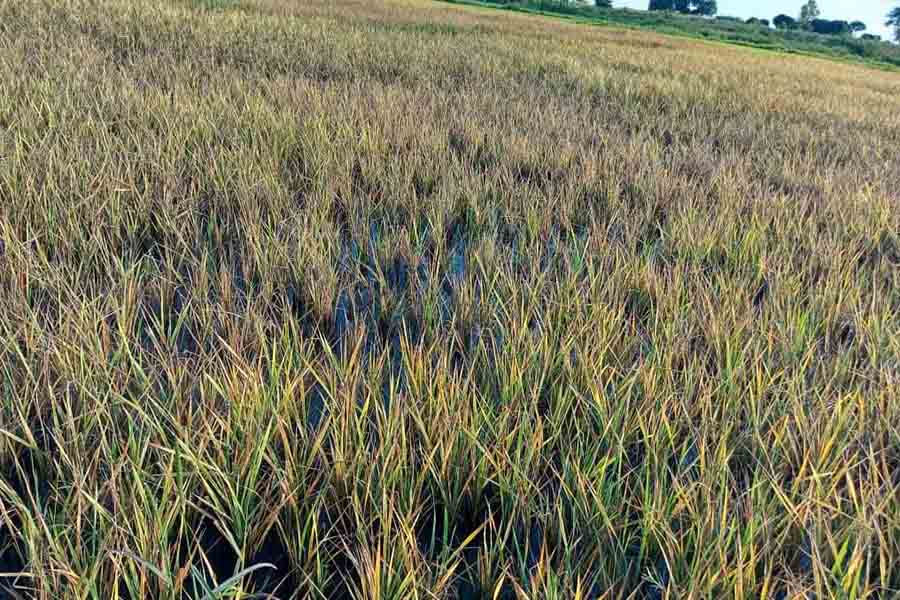
It is the morning of 13 April 2026. Wazanuni walks through what should have been a promising rice field. Instead, his two-acre farm tells a different story. One section has turned yellow. The other is drying up.
What was once a lush green paddy is now showing signs of distress. Leaves are turning yellow prematurely and drying out. The plants are stunted and struggling to grow.
Rice Yellow Mottle Virus, stem borers, and mealybugs have taken their toll.
Wazanuni says the pests and disease spread from a neighbouring rice field into his farm and many others in the area.
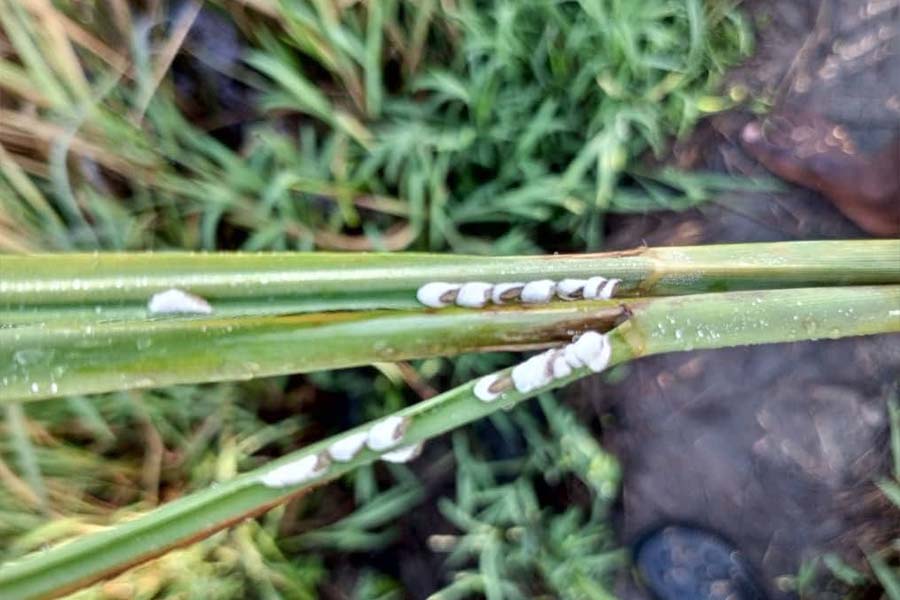
“The disease started in the a neighboring rie field befire spreding in surrounding areas including mine. The rice plants were affected by pests that appeared whitis inside, while the crop looked like it had been set on fire and was wilting,” said Wazanuni.
Several kilometres away, Harried Mpichi, a rice farmer from Chimkwende Village in the area of Traditional Authority Malengachanzi in Nkhotakota District, is facing a similar challenge.
He says his two-month-old rice crop began showing unusual signs. Despite being at an early growth stage, the plants appeared prematurely mature, a clear indication that something was wrong.
Mpichi says the virus and pests devastated his crop.
His harvest dropped dramatically from 40 bags to just one.
“I was shocked to see our rice turning yellow as if it was ready for harvesting despite not havesting panicles. It was at this point when I realized that diseases had hit my rice,” lamented Mpichi
According to Nkhotakota District Director of Agricultural Services, Denis Emmanuel Zingeni, rice was cultivated on 8,859 hectares during the 2026 farming season.
However, Rice Yellow Mottle Virus, stem borers, and mealybugs affected 30.4 hectares, impacting 111 farmers in Mphonde, Linga, and Khunga Extension Planning Areas, which are among the district's major rice-producing zones.
“Most of the field were showing signs of nutrients deficiency. So we advised the farmers to uproot at burn the affected rice plants. ” said Zingeni.
Rice farmers in neighboring Salima district were also not spared.
Emmanuel Chiweyo of Chenyama Village under Traditional Authority Kalonga says his rice crop began showing signs of infection before eventually drying up, despite adequate water in the field.
Together with fellow farmers, Chiweyo applied commonly used pesticides and neem-based remedies, but nothing worked.
It was a disaster.
“We were told to apply some chemicals including Neem but it was all ended in futile,” said bitter Chimenya.
Rice research scientists at Lifuwu Research Station in Salima say Rice Yellow Mottle Virus, stem borers, and mealybugs affected most rice-growing districts during the season.
What is more concerning is that the problem appears to be recurring every year.
Rice research scientist Cornwell Iman says investigations into the outbreak prompted the Ministry of
Agriculture to supply pesticides to affected farmers. However, the results were largely ineffective.
“Those people who reported late the herbicides were not effective, because the rice was already damaged,” revealed Iman.
These are just a few of the many farmers affected by the outbreak this year.
Rice Yellow Mottle Virus, which has been reported in several African rice-growing countries including Malawi, Tanzania, Madagascar, and Uganda, attacks rice plants by damaging their ability to grow and produce grain.
Scientists say yield losses can range from 25 per cent to nearly complete crop failure, depending on the severity of infection.
For Malawi, where rice is increasingly becoming both an important food crop and a source of income, the consequences are alarming.
The virus was first reported in Malawi in April 2014, according to the 2015 publication First Report of Rice Yellow Mottle Virus in Rice in Malawi by the Food and Agriculture Organization's AGRIS International System for Agricultural Science and Technology.
Since its discovery near Kisumu, Kenya, in 1966, the virus has spread across most rice-growing countries in West and Central Africa.
In East Africa, it was reported in Tanzania and Madagascar during the 1990s before spreading to Uganda, Rwanda, Burundi, and the Democratic Republic of Congo between 2006 and 2012.
Rice is Malawi's second most important cereal crop after maize. As such, the increasing prevalence of Rice Yellow Mottle Virus presents a serious threat to food security and household incomes.
Climate change appears to be making the situation worse.
As Malawi continues to experience climate-related shocks, scientists say building resilient agricultural systems is no longer optional. It is urgent.
This is where biotechnology and modern agricultural science enter the conversation.
Several African countries have conducted or approved confined field trials and research on genetically modified rice varieties, including nitrogen-efficient, water-efficient, and salt-tolerant strains such as NEWEST Rice.
Countries such as Ghana and Nigeria have undertaken research and field trials aimed at developing rice varieties capable of withstanding environmental stresses while maintaining productivity.
Kingdom Kwapata, a biotechnology research scientist at the Lilongwe University of Agriculture and Natural Resources (LUANAR), believes Malawi should give serious consideration to developing genetically modified rice varieties.
He argues that climate change is creating new production challenges that conventional breeding alone may struggle to address.
Kwapata says Malawi needs to invest more in research to develop rice varieties that can withstand diseases, pests, and climate-related stresses, thereby supporting a more resilient rice sector.
He also warns that heavy reliance on chemicals increases production costs for farmers while posing potential risks to human health and the environment.
“Our production of rice is a bit retarding because we are using very archaic way of growing Rice with the lack of technology. Introducing GM rice could resolve all these issue. This is long overdue,
Agricultural expert Gresham Kamwendo Kamnyamata supports increased investment in technological research, including the development of genetically modified rice varieties.
He says Malawi cannot afford to watch food production decline when scientific solutions exist to address emerging agricultural challenges.
Kamnyamata is calling on government to increase funding for agricultural research institutions to support the development of disease-resistant and climate-resilient crops.
“Such kind of research need quite a lot of resources. I urge the government and partners to support institution that are into research. The population is growing and it needs food,” noted Kamnyamata.
However, not everyone believes the conversation should focus solely on biotechnology.
Farmers Union of Malawi Chief Executive Officer Jacob Nyirongo acknowledges the impact of Rice Yellow Mottle Virus but says broader discussions are needed before introducing genetically modified rice.
He says policymakers must consider potential effects on trade, exports, and market acceptance.
“GM rice is a solution but not a sole solution. We need to also look at the risks which this could have on the country’s trade. Other country don’t buy such crops,” Nyirongo noted.
Biotechnology is increasingly being recognised as an important tool for strengthening crop resilience.
Genetically modified crops are developed by introducing specific traits that enable plants to resist diseases, tolerate pests, withstand environmental stresses, or improve productivity while maintaining high yields.
Across Africa, researchers are using advanced breeding techniques and biotechnology tools to develop rice varieties capable of resisting diseases and adapting to changing climatic conditions.
Malawi has already witnessed the potential of biotechnology.
Several years ago, scientists at LUANAR developed genetically modified Bt cotton, which farmers adopted to reduce losses caused by destructive pests. Positive results were reported.
The country is also exploring genetically modified maize varieties designed to combat fall armyworm infestations and improve resilience to climate change.
Without stronger investment in science, farmer education, and resilient agricultural technologies, experts warn that crop production challenges could become increasingly severe.
The threat extends beyond individual farms.
According to World Bank trade data for 2024, Malawi exported approximately US$93,550 worth of rice, making it the world's 129th largest rice exporter.
While rice exports represent only one aspect of the crop's economic value, the figures highlight its growing role in both domestic and international markets.
Continued production losses could affect Malawi's ability to meet local demand and expand its export potential.
At the farm level, the challenge is already evident.
Experts say the spread of Rice Yellow Mottle Virus is partly linked to the repeated use of infected planting materials and inadequate disease management practices.
The virus presents a particularly difficult challenge because infected plants cannot be cured using chemical treatments.
Management therefore relies on preventive measures, resistant varieties where available, and efforts to limit disease transmission.
The virus spreads through infected planting material, insect vectors, contaminated farm tools, irrigation water, animals, and direct plant-to-plant contact.
Agricultural experts stress that early diagnosis is critical.
Yet for many farmers with limited access to extension services, identifying the disease in its early stages remains difficult.
As a result, infected fields often continue to serve as sources of transmission while farmers expend scarce resources on crops unlikely to recover.
National Commission for Science and Technology Senior Research and Science Officer for Agriculture and Natural Sciences, Yohane Chimbalanga, says the Commission supports the use of scientific innovations to address challenges affecting agriculture and other sectors.
“NCST together with its stakeholders do conduct situation analysis to understand the challenge and its severity. Then we look around for technologies that can address such challenges especially in agriculture. Scientific solutions for challenges affecting the agriculture sector are supported,” He said.
The proposed situation analysis could help determine the scale of the outbreak, identify the primary causes of crop damage, and establish the most effective interventions.
Experts also emphasize the need for stronger agricultural extension services and better communication of scientific information to farming communities.
For farmers such as Wazanuni, Mpichi, and Chiweyo, the need for solutions is immediate.
Their experiences demonstrate how diseases and pests can devastate livelihoods, threaten food security, and undermine agricultural productivity.
Without stronger investment in research, farmer education, and innovative agricultural technologies, experts warn that such outbreaks could become increasingly difficult to manage.
Yet science continues to offer promising solutions.
From disease-resistant rice varieties and improved diagnostic tools to biotechnology and farmer-centred extension systems, emerging innovations have the potential to protect one of Malawi's most important crops.