













ZODIAK ONLINE
ArtBridge House, Area 47
Sect. 5, P/Bag 312
Lilongwe, Malawi
Sect. 5, P/Bag 312
Lilongwe, Malawi

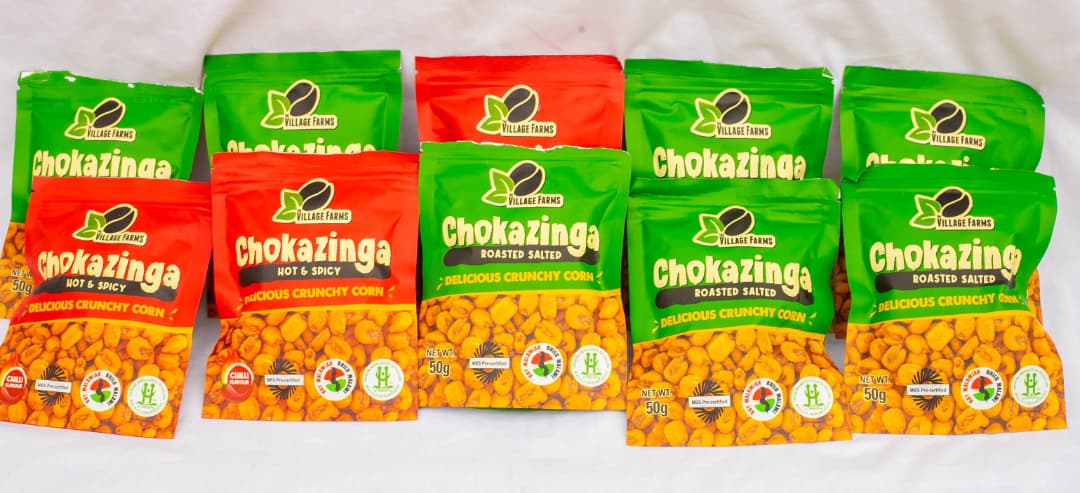
Village Farms Ltd did not begin as a snack company. It began, quite simply, as a farming operation - grounded in the soil, seasons, and risks that every Malawian farmer understands intimately.
In one particular year, Village Farms made a bold production push: 65 hectares of groundnuts and 8 hectares of maize. Unfortunately, the rains failed. What followed was devastating - a near total crop loss. For any farmer, this would have been the end of the story. For Village Farms, it became the beginning of a new one.
Out of that setback came a hard but transformative question: what can we do differently with what we still have? The answer was value addition. With the little maize that survived, the idea of roasting and packaging maize - something deeply familiar to most Malawians - naturally emerged.
The inspiration was both personal and regional. Many of us grew up carrying roasted maize packed and soaking in used cooking oil plastic bottles while at primary school and paperbacks of chokazinga mixed with nuts to secondary boarding schools. It was currency! Further inspiration came from across the border in Uganda, where roasted maize, popularly known as mberenge, is a beloved everyday snack. That combination of memory, culture, and practicality sparked what would become Village Farms Chokazinga.
Village Farms Ltd is proudly woman-led, with Pachalo Msukwa serving as the co-founder and Managing Director. The company’s journey is a story of resilience, innovation, and a clear belief that Malawian products, done right, can compete confidently on modern shelves.
Chokazinga has recently achieved pre-certification by the Malawi Bureau of Standards (MBS), a critical milestone that has unlocked entry into formal retail markets.
Distribution has now begun in major supermarkets in Lilongwe and Mzuzu and Blantyre. Through strategic partnerships with retailers that operate multiple outlets, Village Farms is positioning Chokazinga to reach the rest of the country and beyond via existing and new distribution networks.

The market reception so far has been overwhelmingly positive. Consumers consistently describe the experience as nostalgic, “it tastes like home.” It is familiar yet refined: the same roasted maize people love, but cleaner, better packaged, and shelf-stable. Many first-time buyers quickly become repeat customers, often returning with friends or family members in tow.
Quietly, Village Farms Chokazinga is becoming one of those products people recommend with a smile, and if you haven’t tried it yet, chances are someone close to you already has.
One of Chokazinga’s strongest advantages is its universality.
Because it is both crunchy and soft, it cuts across age groups, income levels, and lifestyles. Children enjoy it. Busy adults snack on it. Families share it. It works just as well on a long drive as it does during a workday or an evening at home.
In short, Village Farms Chokazinga is a snack for everyone, anytime, a rare quality in an increasingly segmented food market.
The growth outlook for Village Farms and Chokazinga is strong. Demand is already outpacing initial expectations, and expansion into Blantyre and other urban centers is significantly widening the consumer base.

That said, like many Malawian businesses, Village Farms faces structural barriers—particularly a taxation regime that places a heavy burden on growing enterprises, making scale-up more expensive and complex than it needs to be. Addressing these constraints would unlock faster growth, create more jobs, and strengthen local sourcing from smallholder farmers.
In addition, access to financing to support growth remains extremely limited. Many existing financial products are not designed for the realities of small and growing businesses. Financial institutions often require levels of documentation and institutional structures that are difficult for emerging enterprises to maintain, including auditors, legal support, human resource functions, procurement systems, and marketing departments.
What is often overlooked is that preparing such documentation, conducting valuations, and meeting compliance requirements come at a significant cost—costs that many small businesses must balance against the need to invest directly into production, staffing, and growth. More flexible and context-responsive financing solutions would significantly improve the ability of businesses like Village Farms to scale sustainably.
Village Farms takes standards seriously. Chokazinga’s pre-certification by MBS is a testament of the company’s commitment to quality, safety, and compliance. Full certification processes are underway, reinforcing confidence among retailers, regulators, and consumers alike.
This focus on standards is central to the Buy Malawi agenda: proving that locally produced goods can meet, and exceed, modern expectations.
Village Farms Chokazinga is more than a snack. It is a story of resilience, memory, and modern Malawian entrepreneurship. It represents what is possible when local producers turn adversity into opportunity, and when consumers choose to support products that are truly homegrown.
And if you haven’t tasted it yet?
You may soon find yourself wondering how everyone else already has.