












ZODIAK ONLINE
ArtBridge House, Area 47
Sect. 5, P/Bag 312
Lilongwe, Malawi
Sect. 5, P/Bag 312
Lilongwe, Malawi

If you go on Facebook and search, Online Maths Expo, you will find hundreds of posts teaching students how to deal with different mathematical problems. In short, this page covers almost everything.
Mathematics is only one example of the many subjects now taught online. In today’s digital age, learners can easily access lessons in science, languages, history, and even vocational skills with just a few clicks.
These pages attract thousands of children and young learners, demonstrating how Facebook has evolved beyond its original purpose of social interaction. It has become a hub for education, a marketplace, and even a source of employment for many content creators.
This transformation highlights the dual nature of social media: while it offers immense opportunities for learning and growth, it also introduces risks that must be carefully managed.
13-year-old Raisa Rjab, from Mboni Area in Mtsiliza Township, who is in Form One at Chigoneka Community Day Secondary School, has just reached the minimum age required to create a Facebook account. She is now an active user of the platform.
Raisa explains that she uses Facebook to learn subjects she struggles with in class, finding educational pages and posts that help her understand difficult concepts. However, she also expresses concern about the amount of inappropriate content circulating on the platform.
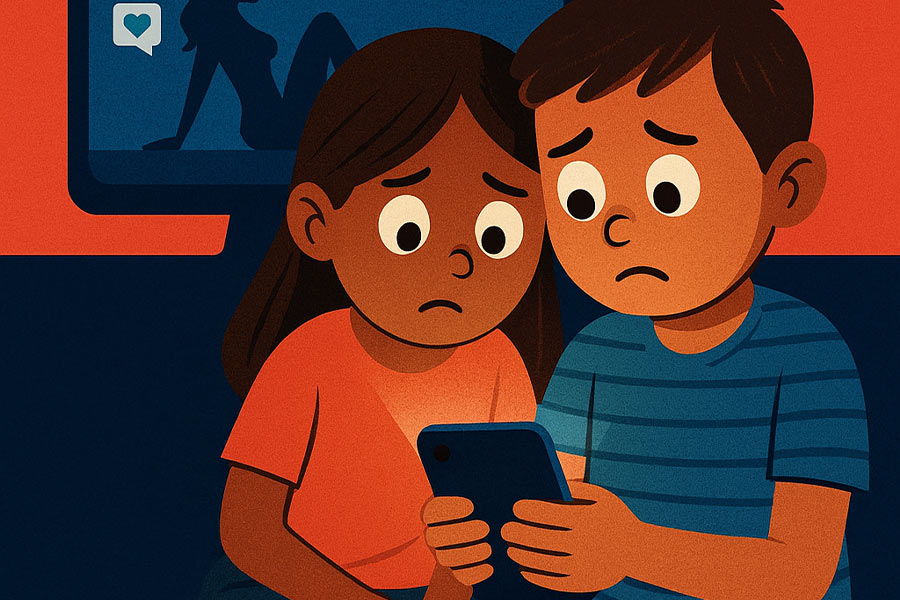
“If children like me start watching this kind of content, they may develop the urge to imitate what they see. As a result, they could end up getting into trouble, being influenced in harmful ways, or even contracting diseases,” she says.
For children like her, such material is not only distracting but potentially harmful, raising serious questions about the safety of young learners online.
The purpose of this analysis is to emphasize the responsibility of all stakeholders; Facebook users, content creators, regulators, and Meta itself, in ensuring that children are protected when engaging with educational content online. Parents, too, play a critical role in monitoring and guiding their children’s digital experiences.
This concern is particularly urgent given the rise of explicit and sexual content on Facebook, shared by users such as Queen Nadia TV and others who engage in harmful behaviors.

One of Malawi’s content creators, Felistus Ngwira, better known as Nya Uyu of the Vilekeke Kingdom, highlights three key points in her analysis of this matter.
First, she notes that the rise in sexual and inappropriate content is partly due to some local content creators who promote and share such material without facing any sanctions. Second, she points to Facebook’s weakness, as some content reaches audiences without effective control. Finally, she stresses the need for parents to step up in monitoring their children.
She said: “It’s a two-way issue. First, there are things beyond our control. For example, when you go on social media, Facebook in particular, you might be minding your own business, and suddenly these things just pop up.
“Second, I have a problem with people posting about such content, talking about it, and creating curiosity. As a result, people who didn’t even know about it end up going to watch."
Ngwira added that the desperation for views and monetization is driving content creators to post sexual material.
She noted, “There are people doing amazing things out there, but pages don’t want to highlight positive stories. Instead, they prefer posting scandals, nudes, and similar content because that’s what brings them numbers. Now, it has all become a game of numbers.”
Jimmy Kainja is a senior lecturer in communication at the University of Malawi. He agrees with points raised by Nya Uyu regarding local enforcement and the responsibility of parents in monitoring what their children are doing online.
However, he notes that there is a difference on Facebook when it comes to community monitoring in countries that lack the authority to take action against the platform or summon its owner, Mark Zuckerberg.
He stresses that African countries are at a disadvantage compared to European countries such as the UK, which can summon Zuckerberg.
Nonetheless, Kainja emphasizes that as a nation, we cannot leave everything solely to Facebook’s monitoring team.
“We tend to be reactionary when it comes to these issues. Just because something is happening on Facebook, we immediately see it as a big problem. But the potential goes beyond Facebook.
“The platform may block whatever is happening today, yet these kids can still access similar content elsewhere on the internet. Facebook is just one platform—it’s part of the wider internet, and the content is available in many other places,” Kainja argued.
Some may argue that the people creating sexual content on Facebook are not Malawians, and therefore it is a waste of time to discuss them since our local authorities cannot do anything about them.
But that argument misses the point. Facebook is a global social community, and what happens anywhere in the world can affect children in Malawi as long as they have access to such content.
Imagine this: a Zimbabwean content creator known as Queen Nadia TV was able to reach 1 billion views within just 7 days and generate more than 5,000 US dollars from Facebook through videos flaunting private parts.
What impact could this have on children? To help us answer that, we engaged another local content creator and social media influencer, Gerald Kampanikiza, better known as GKC.
“If we tolerate this behavior, it means that future generations will also believe this is the proper way to earn money,” he stressed.

At a Data Protection Conference in Lilongwe last week, the Minister of Information, Shadreck Namalomba, directed the Malawi Communications Regulatory Authority (MACRA) to develop stronger enforcement mechanisms for what is happening on Facebook.
He emphasized that Malawi, as a society, should not leave this responsibility solely to Meta, or Facebook: “We need to develop systems that can integrate with Meta so that, when these issues arise, we are able to monitor them effectively. This way, we can take immediate action.
As we conclude this discussion, it has become clear from this analysis that protecting children on Facebook from harmful content is not the responsibility of one individual. It requires a collective effort, as University of Malawi Communication Senior Lecturer Kainja emphasizes.