
















ZODIAK ONLINE
ArtBridge House, Area 47
Sect. 5, P/Bag 312
Lilongwe, Malawi
Sect. 5, P/Bag 312
Lilongwe, Malawi

On a small plot in Katundu Village, Traditional Authority Chimaliro in Thyolo, John Grant counted his 4,000 tomato plants, applied fertilizer twice and invested another K15,000 in three kilograms of NPK 23-21-0+4S fertilizer from an agro-dealer at Goliati Trading Centre. A neighbor’s warning about that unscrupulous vendor sent him home to rub the granules between his fingers.
The particles dissolved into ash and Urea, not NPK. When he confronted the dealer, the man confessed he had mixed three bags of Urea fertilizer with ash because real NPK was expensive and scarce. He returned Grant’s money and begged him to stay silent.
"I bought that fake fertilizer at the vendor's shop on May 29, 2026. This is a common malpractice here and requires care when buying inputs. It's either you buy fertilizers which is mixed with sand, soil, lime and other foreign materials, or inputs with fake labels, and underweight. I was luck because with that mixture, my tomato plants could have wilted," Grant said.
He added," most vendors here are after making profits".
Months earlier, Grant had bought what he thought was Dithine pesticide at the same Trading Centre, only to discover it was a mix of Luni herbs commonly known as purslane and other particles.
"When I sprayed it to my tomatoes, I realized that it was not the original Dithine. The color, smell were all different, a typical of Luni. Again, after some few days, there was nothing that changed to my tomato plants as expected. It could not control fungal diseases like blight, leaf spot, downy mildew, rust, and anthracnose," he said.
In Goliati, where irrigation farming feeds Thyolo, Chiradzulu and Limbe with tomatoes, cabbage, beans, carrots, and onions, farmers are planting hope and harvesting deception.
Kilometers away from Thyolo, at Chinakanaka market in Mulanje district, another farmer Chikondi Kuphata, recently bought three Kgs of NPK fertilizer mixed with sand. She wanted to apply to maize at her backyard field.
"I bought NPK and Urea from a vendor at the market, but I observed while home that the NPK was mixed with sand. I just disposed it of and only used the Urea," she said.
The Malawi Bureau of Standards (MBS) calls it a crisis of trust.
Its recent surveillance showed traders adulterating fertilizer with sand, soil and lime. Others use fake labels to mimic MBS-certified brands, while backyard producers repackaged organic and compost fertilizers without certification. Some packages weighed less than declared, in breach of the Metrology Act, and many carried poor or missing labels.
On June 8, 2026, the Competition and Fair Trading Commission (CFTC) slapped Nitro Phos Limited with a K50 million fine for supplying defective CAN fertilizer that caused crop failure for farmers across multiple districts in the 2025/2026 farming season. The MBS confirmed that certain batches failed to meet nutrient and moisture specifications.
To further highlight the scale of the problem, police in Lilongwe arrested two men on June 26, 2026 for allegedly being in possession of 670 bags of counterfeit NPK fertilizer bearing the Export Trading Group (ETG) logo.
Kanengo Police Public Relations Officer Macfarlen Mseteka, said the arrests of suspects, Matius Bonongwe, 33, and Timothy Matias, 26 followed an operation targeting the illegal manufacturers and sale of fake farm inputs.
"The detectives first recovered the counterfeit fertilizer from Bonongwe’s warehouse in Kanengo and he disclosed to had bought the consignment from Matias, which led to Matias’ arrest and the recovery of the consignment which suspects claimed was purchased from Mozambique," Mseteka said.
The rot extends beyond the farm. On June 1, 2026 MBS impounded 300 bales of expired Meru soya chunks from Price Worthy Wholesalers in Limbe, Blantyre and fined the trader K3 million.
Three days later in Kanengo, Lilongwe, officers shut down Fytu Investments for manufacturing toilet paper without certification under unhygienic conditions, slapping it with a K2.4 million fine.
This is after on May 17, 2026, 68 packs of blueberries were quarantined at Chipiku Plus in Mzuzu for failing labeling standards, costing the retailer K900,000. From the soil to the shelf, and pharmacies, products meant to nourish Malawians are being compromised.
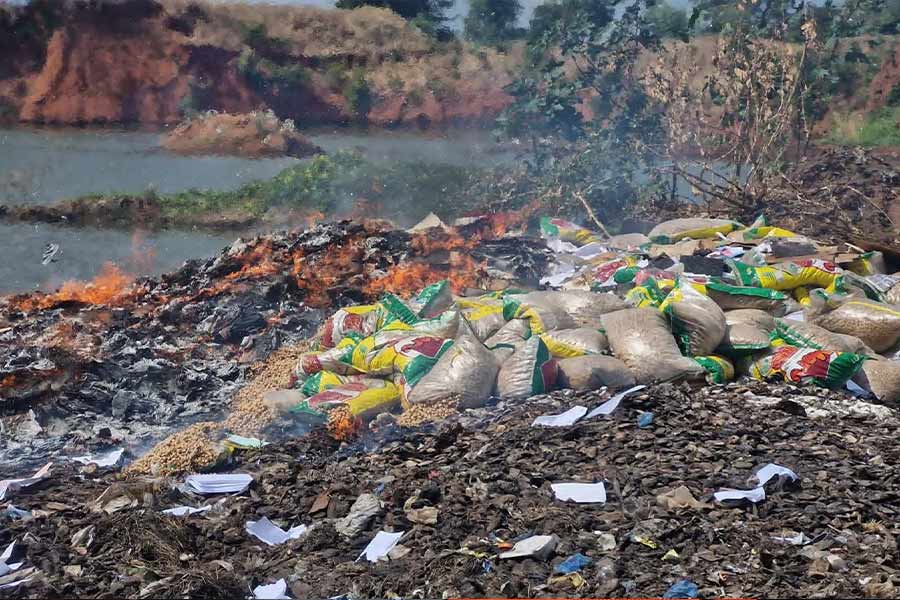
Speaking during a product disposal exercise, MBS Public Relations Officer Annie Maliha assured Malawians that it will continue conducting inspections in shops and markets across the country to ensure consumers purchase and use safe and quality products.
For farmers, the cost is measured in lost seasons. Fake pesticides flood markets every harvesting period, fueling post-harvest losses that the World Food Programme (WFP) estimates at 20 to 30 percent of Malawi’s annual yields. As for the use of expired drugs it leads to mortuaries.
The Pesticides Control Board (PCB) told Zodiak that in conjunction with police, it arrested 20 illegal agro-dealers in February and March 2026 alone for selling pesticides without papers.

According to PCB Spokesperson Lesen Banda, the board is now collaborating with the police at borders and roadblocks while sensitizing farmers to verify chemicals before buying.
Food and agriculture expert Gresham Kamnyamata applauds the crackdown but warns that MBS and other agencies must join forces to end the malpractice.
"I am calling upon all relevant agencies like Malawi Bureau of Standards, the police and PCB to aid in ending the malpractice," he said.
A 2024 study by the Kamuzu University of Health Sciences (KUHES) shows that nearly 14 percent of essential medicines, including antibiotics, fail to meet required quality standards, raising serious public health concerns.
The Catholic Commission of Justice and Peace (CCJP) in its statement released on June 4, 2026 titled "These Wounds We Inflict Ourselves: A Call for National Introspection," also strongly touched on the situation.
Co-signed by CCJP National Coordinator Lewis Msiyadungu and all the Diocesan secretaries, it noted that there is growing concern over the increasing presence of falsified and substandard medicines in Malawi, a development that points to a deeper ethical and systemic crisis within the health sector. It further stressed that this problem is no longer isolated, but steadily worsening.
This year at Kamuzu Central Hospital in Lilongwe, it was reported that four children died after receiving expired insulin which was re-labeled.
"It is disappointing to learn of cases involving expired insulin and falsified drug labels supplied to major referral hospitals, including incidents where expired insulin was allegedly re-labelled and distributed across key health facilities after being stolen from hospital storage and disguised to conceal expiry dates and batch information,"...reads the statement in part.
The statement added that while this has been the case, there have not been sufficient sanctions to address this matter.
Consumer Association of Malawi (CAMA) Executive Director John Kapito says traders know the laws that govern their businesses and market abuses are not allowed.
Kapito stresses that both traders and consumers have a role to play. He says consumer education on expiry dates and product verification has been shared widely through the media.
“Consumers are perfect inspectors,” Kapito said. “The continued poor market practices can only be eliminated by consumers themselves. They already have the necessary information.”
He urged consumers to refuse expired and unhygienic products even if cheap; check labels and contents before paying; and report substandard goods to trade officers, market officials, MBS, and CAMA.
“Most consumers hide behind poverty and make excuses due to lower prices of substandard products. No consumer is excluded, both educated and uneducated are engaged in these malpractices. The trend will only end once the consumer who is King in these circumstances is able to stop buying such products," Kapito concluded.
Until then, every bag of fertilizer rubbed between a farmer’s fingers and every pesticide sprayed on stored maize and other cash crops carry a question Malawi cannot afford to ignore: will this season feed the nation, or will the poison in the bag eat the harvest first?