


















ZODIAK ONLINE
ArtBridge House, Area 47
Sect. 5, P/Bag 312
Lilongwe, Malawi
Sect. 5, P/Bag 312
Lilongwe, Malawi


The dramatic foiling of a transformer vandalism attempt in Thyolo has become a powerful symbol of what can happen when communities, security personnel and law enforcement unite to protect national infrastructure.
On the night of June 21, 2026, a group of nine suspected vandals targeted an ESCOM transformer at Kumadzi Tea Estate in Thyolo. The criminals tied up estate guards before pulling down a 100 kVA transformer with the intention of extracting valuable copper windings. But their plan was disrupted by the courage of one guard who managed to free himself and raise the alarm.
Within a short time, estate management, members of the Khonjeni Police Forum and community patrol teams mobilised and pursued the suspects. Their efforts resulted in the arrest of four men while the remaining suspects fled.
The Electricity Supply Corporation of Malawi (ESCOM) has since described the intervention as an inspiring example of community ownership and patriotism.
"While we strongly condemn this destructive behaviour, we express our profound gratitude to the brave estate guards and vigilant community members who courageously stepped in to halt this crime," said ESCOM Chief Public Relations and Communications Officer Pilirani Phiri.
He said the response demonstrated the growing determination among Malawians to defend critical public infrastructure.
"This proactive intervention sends a powerful message that citizens are watching and will actively defend their ESCOM infrastructure in their communities," Phiri said.
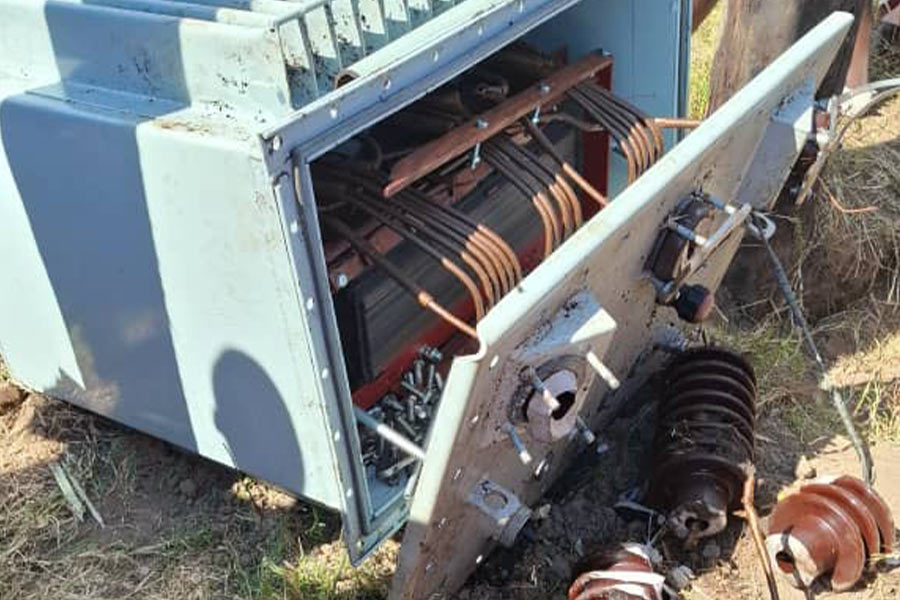
According to ESCOM, the attempted theft was not merely a criminal act against company property but an attack on national development.
"Vandalism is a direct assault on national development. Resources that should be used to expand electricity access are instead diverted to replacing damaged transformers and other infrastructure," he said.
Phiri further emphasized that community vigilance remains one of the strongest weapons against vandalism.
"Continuous public sensitisation and a deep sense of community ownership remain ESCOM's strongest shields against vandalism," he said.
The arrests in Thyolo come at a time when infrastructure vandalism has reached alarming levels across Malawi.
Police at Luchenza identified the suspects as Emmanuel Zulu, 31, of Milenga Village, Traditional Authority Mphuka; Raphael Katopola, 52, of Chikhwaza Village, Traditional Authority Chimaliro; Steve Elaton, 27, of Mulunda, Traditional Authority Mbawela; and Paul Kabudula, 40, of Nguluwe Village, Traditional Authority Bvumbwe, all from Thyolo District.
According to South East Police spokesperson Edward Kabango, investigations have linked the suspects to similar offences in the district, while efforts are continuing to apprehend the remaining members of the group.
The successful intervention in Thyolo mirrors another remarkable victory recorded in Zomba earlier this month.
On June 3, 2026, a joint patrol team comprising police officers and community members thwarted an attempted transformer vandalism at Nazinomwe Village. The suspected criminals had already disconnected high-voltage fuses and cut approximately 1.5 metres of earth mat before abandoning their operation and fleeing upon spotting the approaching patrol team.
All stolen materials were recovered and the transformer was saved from further damage.
In praising the Zomba communities, ESCOM noted that such successes were the result of organised and determined community night patrols that have emerged in response to growing syndicated vandalism across the country.
Behind these incidents lies a growing national crisis.
According to ESCOM records, 138 cases of vandalism were reported between October 2025 and March 2026, resulting in damage to 40 transformers. In April 2026 alone, five transformers were vandalised, while another was targeted in Zomba during May.
For many Malawians, the consequences go far beyond damaged equipment.
The late Jailos Solomon, a security guard at Malamulo Health Sciences in Thyolo who lost his life in circumstances linked to criminal activities surrounding infrastructure vandalism, remains a painful reminder of the human cost associated with the vice.
Solomon was 34. He took the night shift at the institution because the pay could cover school fees for his children and provide something extra for his family in Mkusa Village, Senior Chief Khwethemule in the district.
On the night of January 23, 2026, he stood guard with Chikondi Samson, 34, and Yolamu Chilapani, 43, at a pumping dam within the campus. Nearby stood an ESCOM transformer that powers the water pumping system, a hospital, a s ezecondary school and a college. None of them knew the transformer would become their enemy.
Around midnight, a gang armed with panga knives and axes moved through the darkness.
For 37-year-old Edda Welemu, life changed forever in the early hours of that day.
Her husband, was not only the family's breadwinner but also the father of their five children, the youngest just five years old. Six months after his death, his widow Welemu continues to struggle to support their children while awaiting gratuity benefits from his former employer. Their eldest child, who scored 19 points in the Malawi School Certificate of Education examinations and has been selected to study at Chancellor College, now faces an uncertain future due to financial constraints.
The story illustrates how vandalism and related criminal activities affect not only institutions but also families whose lives are forever altered.
The economic consequences are equally severe. In Thyolo, it becomes dire as the produrer of the country's second forex earner, tea is always affected during the vandalism-induced blackouts.
At Nchima Tea Estate in Thyolo, Senior Operations Manager Amit Nain said frequent power disruptions and vandalism have forced the estate to rely heavily on diesel generators.
"Generating electricity through diesel generators is nearly four times more expensive than using ESCOM power. The inconsistent power supply also negatively affects the quality of tea production," he said.
ESCOM estimates that it loses more than K3 billion annually in indirect costs associated with vandalism. Funds that could otherwise be invested in extending electricity to underserved communities are instead spent replacing damaged transformers, cables and other infrastructure.
"We are not just losing equipment. We are losing life and development opportunities. Infrastructure vandalism is not only a commercial threat, but also a direct attack on national development," lamented Phiri.
To address the crisis, ESCOM has launched what it describes as a high-stakes nationwide campaign aimed at increasing public awareness and dismantling criminal networks behind infrastructure destruction.
Experts warn that Malawi's challenge reflects a broader regional problem.
Energy expert Dr Suzgo Kaunda of the Malawi University of Business and Applied Sciences said increasing demand for scrap metal and weak protection systems have fuelled vandalism across Africa.
"Investment in protection and public awareness is urgently needed because vandalism slows development and undermines the operations of the country's power utility provider," Kaunda said.
In response to rampant theft of critical infrastructure, the Malawi Government suspended the export of scrap metal in 2023. The ban followed widespread vandalism involving ESCOM power lines, water board infrastructure, telecommunications equipment and railway materials.
Authorities are currently reviewing the Second-hand and Scrap Metal Dealers Act and developing new standard operating procedures and registration requirements before any regulated scrap metal trade can resume.
Security analyst Dr Sheriff Kaisi believes some incidents may involve individuals with technical knowledge of electricity infrastructure.
"One would not just wake up and take down a transformer or copper wire. ESCOM should strengthen staff retention, train guards with specialised security skills and work closely with communities on undercover surveillance," he said.
Kaisi also called for stiffer punishments against offenders to deter future attacks.
Thyolo District Commissioner Noel Dakamau echoed those concerns, warning that transformer vandalism poses a serious threat to local development.
"Equipment like transformers are very expensive. Do not harbour thieves in your homes. Be alert and report suspicious activities," he urged.
For Dakamau, as for ESCOM, the answer lies in stronger partnerships between citizens, local leaders, law enforcement agencies and utility providers.
The stories emerging from Thyolo and Zomba demonstrate that communities are increasingly embracing that responsibility.
The guards who risked their lives, the villagers who joined patrols, the police forum members who chased suspects through the night and the ordinary citizens who remain vigilant have become the first line of defence against a crime that threatens Malawi's development ambitions.
Their actions protected more than transformers.
They protected businesses from costly outages, students from interrupted studies, health facilities from service disruptions and communities from darkness.
Most importantly, they demonstrated that when citizens take ownership of public infrastructure, criminals lose their greatest advantage.
As Malawi intensifies efforts to combat vandalism, the courage displayed by the guards and communities of Thyolo and Zomba offers a powerful lesson: safeguarding the nation's development is not solely the responsibility of ESCOM or the police. It is a shared duty that belongs to every Malawian.
In protecting the country's transformers, these ordinary heroes are protecting the future itself.